Candidates competing in key United States Senate races clashed during their final debate appearances, with fewer than two weeks remaining before the crucial November 3 midterm elections. The political debates highlighted deep ideological divisions as both parties fight for majority control of the upper congressional chamber. Republicans currently maintain a narrow lead in the Senate, holding 53 of the 100 seats, while Democrats hold 45 seats alongside two caucusing independent senators.
In Michigan, Democratic nominee Abdul El-Sayed and Republican candidate Mike Rogers held an intense debate centered on international security and regional economic pressures. Addressing trade policies, Rogers distanced himself slightly from former President Donald Trump’s blanket tariff strategy, characterizing tariffs as a “mixed bag” while expressing doubt regarding specific levies on Canadian imports given Michigan’s integrated automotive manufacturing industry.
Rogers emphasized his local priorities during the debate, stating, “If it’s good for Michigan, I’m going to be for it. If it’s bad for Michigan, I’m going to be against it.” He pushed back against El-Sayed’s frequent references to the former president, remarking, “The bingo game ought to be how many times can he put the word Trump in any answer that he has given in the last, whatever, 30 minutes. It’s ridiculous.”
International conflict featured prominently in the Michigan debate. El-Sayed tied rising domestic living costs directly to regional military actions, pointing to severe spikes in retail energy and grocery prices. Connecting rising gas prices to foreign policy decisions, El-Sayed asserted, “The consequences of this war are that you are paying nearly $5 in gas. You’re paying more in groceries because of the price of diesel.”
El-Sayed further criticized Rogers’ foreign policy record, arguing, “Donald Trump is on the ballot through Mike Rogers. They are hip-to-hip on this war, and you are paying the cost.” He added, “Mike Rogers has been promoting this war since before he was in Congress. He’s got a war for everything, and he won’t back off the war now.”
Tensions escalated as Rogers reached out to moderate primary voters, declaring, “If you were a Haley Stevens voter and you came out of this and you said, ‘Man, I just can’t do it. He’s too extreme,’ well, guess what? You’ll have a home with us.” Rogers also challenged El-Sayed’s national security credentials, stating, “You can grin and you can smile and you can talk real pretty, but I’m going to tell you what, that is a risk to our national security.” El-Sayed swiftly rejected the accusations as shameful, while the candidates also clashed over immigration enforcement and border security.
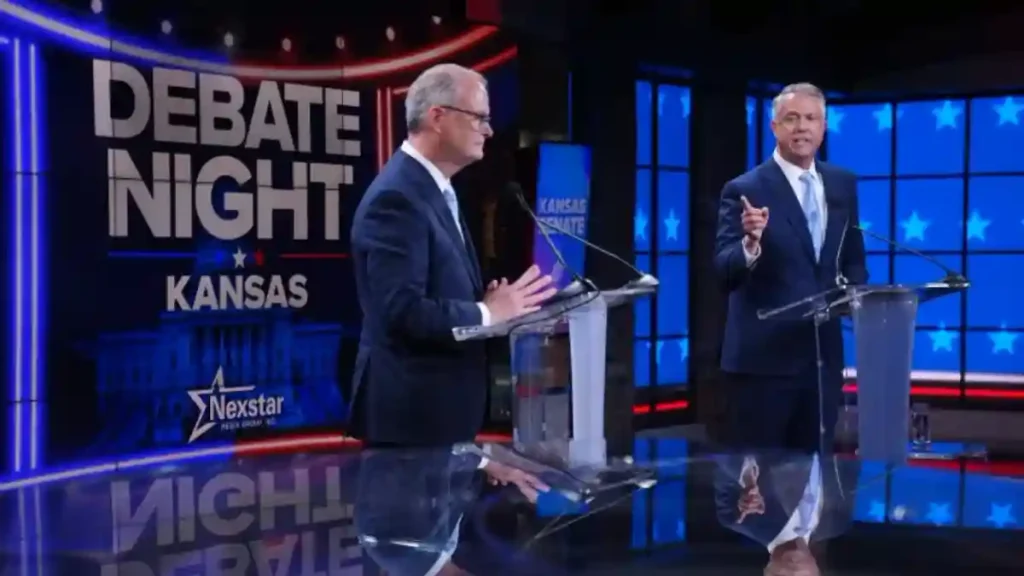
Simultaneously in Kansas, incumbent Republican Senator Roger Marshall faced off against Democratic challenger Adam Hamilton. The debate focused heavily on rising fuel prices impacting the state’s vital agricultural sector. Addressing proposals regarding international energy reserves, Marshall acknowledged, “It doesn’t sound like a great idea,” before adding, “If this brings Russia to the bargaining table and it ends the war, then I am all for it right now.”
Hamilton strongly criticized the approach, responding, “What you said just now is you’re going to sell out our friends in Ukraine. That’s not OK.” Hamilton blamed the economic squeeze on ongoing military conflicts and advocated for suspending federal fuel taxes, while also taking aim at recent federal law enforcement operations in agricultural communities.
Debating defense assistance to foreign nations, Hamilton voiced opposition to unconditioned military aid, stating, “When you see entire cities flattened in Gaza, now we’re not just talking about rooting out Hamas. They’re using our aid to buy our weapons and then dropping them on innocent civilians. That’s just not OK. It’s not decent. It’s not who we are as Americans.” Marshall defended the traditional security alliance, stating, “I’m sure there is. I’m not sure what it would be,” when asked under what conditions he might block weapon transfers, concluding that Washington must prioritize domestic border security first.
These high-stakes Senate debates demonstrate how deeply foreign policy, inflation, and immigration enforcement intersect with voters’ immediate economic concerns ahead of the midterm elections. The final decisions made by undecided voters in battleground states like Michigan and Kansas will directly determine the balance of power in Washington. Over the coming days, campaign organizations will pour massive resources into turnout operations to rally their bases. The ultimate election outcomes will decide whether the current legislative agenda moves forward or faces strong congressional oversight over the next two years.
Sources / References
- Bridge Michigan Fact Check and Coverage of Michigan Senate Debate
- KCUR / Kansas News Service Debate Report on Marshall vs. Hamilton
- Associated Press Final Michigan Senate Debate Overview
- Official AAA Fuel Gauge Report and Energy Market Data